Short answer. Build from plans if you have carpentry skills, tools and free weekends, and want a custom size. Buy a kit if you want pre-cut parts and a build of a few days. Choose a prefab if you want it done and your site has access for heavy delivery. The base, the wiring and the permit questions are the same on all three routes.
Key facts
- Building an outdoor sauna from plans commonly takes several weekends to a few months of part time work, while a barrel sauna kit typically takes one to two days for two people.
- A prefab outdoor sauna arrives assembled and commonly weighs well over 1,000 pounds, so it needs truck, forklift or crane access to the site.
- A scratch built outdoor sauna needs framing, insulation, a foil vapor barrier, interior cladding, ventilation and a roof, which a kit supplies already cut.
- The base, the electrical circuit and any permit are needed for an outdoor sauna whether it is built from plans, assembled from a kit or delivered prefab.
- The heater of a plan built outdoor sauna has to be matched to the room volume and installed to the clearances in the heater manual.
Plans, kit or prefab: what is the difference?
The difference is who cuts the wood and who puts it together.
- Plans. You buy drawings and a materials list, then source, cut and build everything.
- Kit. The maker cuts and machines every part. You assemble it on your base with basic tools.
- Prefab. The sauna is built in a workshop and arrives finished or in large modules.
| Point | From plans | Kit | Prefab delivered |
|---|---|---|---|
| Skills needed | Framing, roofing, insulation, finish carpentry | Following a manual, basic hand and power tools | None for the build |
| Your time | Several weekends to a few months | About 1 to 4 days | A delivery day |
| Cost level | Lowest in cash if you own tools | Middle | Highest |
| Custom size and layout | Full freedom | Fixed models, some options | Fixed models, some options |
| Main risk | Design and moisture mistakes | Missing or damaged parts, uneven base | Site access, delivery cost |
| Warranty | Only on parts you buy | On the kit and heater | On the whole unit |
What does it take to build an outdoor sauna from plans?
The skills and tools to build a small insulated outbuilding, and the patience to get the details right. A sauna is a shed that has to hold high heat and manage moisture.
A typical plan built sauna has these layers and parts:
- A base and a floor frame.
- Stud walls and a roof frame.
- Insulation in the walls and ceiling.
- A foil vapor barrier on the warm side, with taped seams.
- An air gap, then tongue and groove interior cladding in a suitable softwood.
- Exterior sheathing, siding and roofing.
- Benches, a door made for sauna use, and an intake and exhaust vent.
- A heater sized to the room, with its guard and clearances.
Good plans give dimensions, a cut list and these details. Weak plans give a pretty drawing and leave the hard parts to you. Before you pay for plans, check that they show the vapor barrier, the ventilation path, the bench heights and the heater clearances.
Where plan builds go wrong
- Heater mismatch. The room volume is outside the heater's rated range, or clearances to wood are too small. The heater manual sets both.
- Moisture. A missing or leaky vapor barrier lets steam into the insulation.
- Ventilation. No fresh air path, so the room feels stuffy and dries slowly.
- Wood choice. Resinous or treated lumber inside the hot room. Our guide to cedar and other sauna woods explains what is used and why.
- Budget drift. A sauna door, a heater, roofing and clear cladding cost more than first builders expect.
What does a kit change?
A kit removes the design work and the cutting. Parts arrive pre-cut and usually pre-drilled, with hardware and a manual.
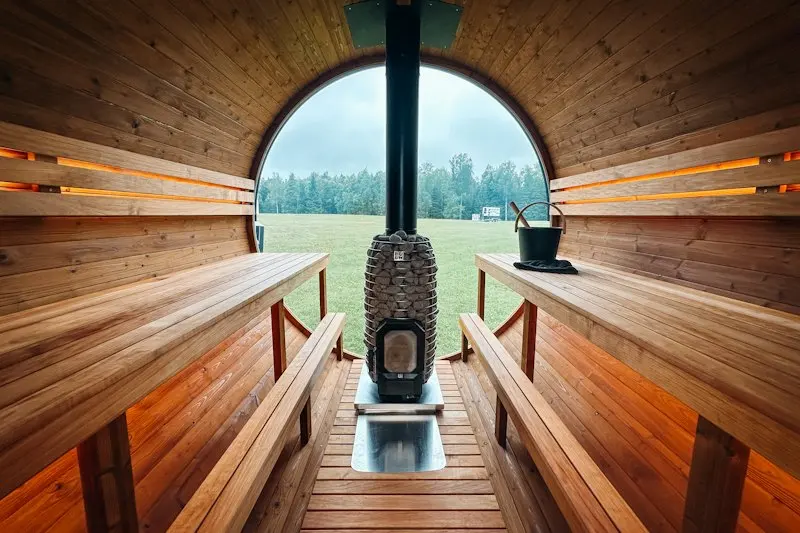
A barrel kit typically goes up in one to two days with two people. A cabin kit commonly takes two to four days, more with an insulated wall system. The steps are covered in how to assemble an outdoor sauna kit.
The trade off is choice. You pick from set sizes, a few wood species and a list of options. Many barrel and solid wall cabin kits have no wall insulation, which a plan build can include. What to compare between kits is in how to choose an outdoor sauna kit.
Kit risks are practical ones: a crate that arrives damaged, a part missing, or a base that is not level, which makes every later step harder. Inspect the delivery before the driver leaves and note damage on the paperwork.
When does a prefab delivered sauna make sense?
When you want the shortest path to a working sauna and the site can take the delivery.
A prefab unit is assembled and often pre-wired inside the cabin. It commonly weighs well over 1,000 pounds. It travels on a flatbed and is set in place with a forklift, a truck mounted crane or a trailer that tilts. Ask the seller what equipment comes with delivery and what clear width and overhead height it needs. A narrow side gate, a slope or overhead lines can end the plan or add a crane bill.
You pay for workshop labor and special freight, so a prefab sits at the top of the price scale for a given size. In return you get one warranty on the whole unit.
How do the costs compare?
In cash, plans are usually the lowest, kits are in the middle and prefab units are the highest. In hours, the order flips.
Three lines do not change with the route you choose:
- The base. See outdoor sauna foundation.
- The electrical circuit for an electric heater, installed by a licensed electrician.
- Permits and inspections, where your town requires them.
Current kit price ranges by size are in cost of an outdoor sauna. If you price a plan build, write the full materials list first, heater and door included, and add a margin for waste and mistakes. Then compare it with a kit of the same size.
Which route fits you?
- Plans: you have built a shed or a deck, own a miter saw and a nailer, and want an odd size or an insulated build.
- Kit: you can follow a manual with a helper, and a standard size suits your yard.
- Prefab: you have no time for a build, the budget allows it, and a truck can reach the spot.
Common questions
Is it cheaper to build an outdoor sauna from plans than to buy a kit?
It can be cheaper in materials, mostly if you already own the tools and value your time at zero. Lumber, insulation, a door, a heater and roofing add up, and mistakes cost extra. Price a full materials list before you assume a saving.
How hard is it to build an outdoor sauna from scratch?
It is about as hard as building a small insulated shed, plus a vapor barrier, heat rated details and ventilation. You need framing, roofing and finish carpentry skills. The electrical connection still belongs to a licensed electrician.
How long does it take to assemble an outdoor sauna kit?
A barrel kit typically takes one to two days for two people. A cabin kit commonly takes two to four days. The base and the electrical work are separate jobs with their own schedule.
What is a prefab outdoor sauna?
A prefab outdoor sauna is built in a workshop and delivered in one piece or in a few large modules. It is ready quickly, costs more than a kit of the same size, and needs clear access for the delivery equipment.
Do I need a permit to build an outdoor sauna from plans?
Possibly. Many towns exempt small accessory buildings under a set size, but electrical work, wood stoves and setbacks often have their own rules. Ask your building department before you buy materials.