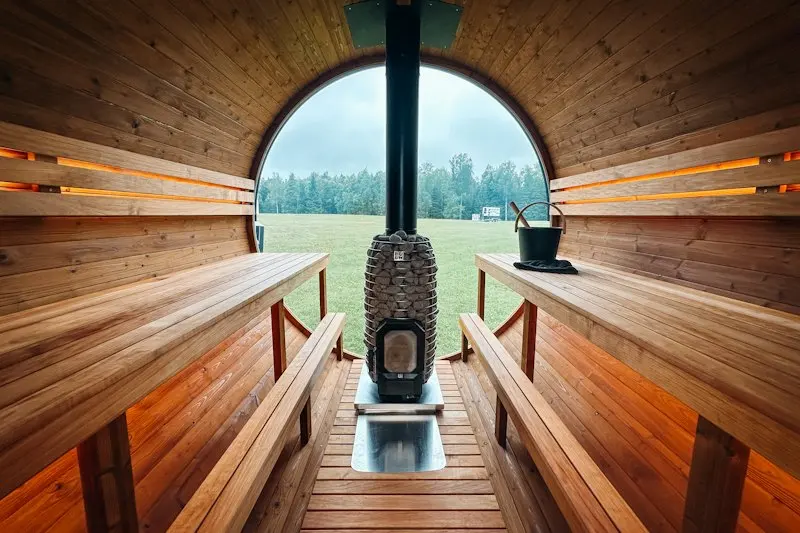
Short answer. A typical electric outdoor sauna heater of 4.5 to 9 kW needs a dedicated 240 volt circuit with a 30 to 50 amp breaker, hardwired through outdoor-rated conduit. The exact breaker and wire size come from the heater manual and the length of the run. A licensed electrician should size and install it, usually under an electrical permit.
Key facts
- Most electric outdoor sauna heaters from 4.5 to 9 kW need a dedicated 240 volt, single phase circuit and are hardwired, not plugged in.
- A 6 kW sauna heater on 240 volts draws 25 amps and is typically installed on a 30 or 40 amp breaker, depending on the heater maker's instructions.
- An 8 kW sauna heater on 240 volts draws about 33 amps, and a 9 kW heater draws about 37.5 amps, so both commonly call for a 40 or 50 amp breaker.
- Sauna heater amps on a 240 volt circuit equal the heater's watts divided by 240, so each kW adds about 4.2 amps.
- Whether an outdoor sauna heater needs GFCI protection depends on the heater maker's instructions and on local electrical code, so it is a question for a licensed electrician.
What are the electrical requirements for an outdoor sauna?
Most outdoor saunas with an electric heater need one dedicated 240 volt, single phase circuit that serves nothing else. Four numbers define it.
- Voltage. 240 volts for nearly all traditional heaters of 4.5 kW and up.
- Amps. Set by the heater's power in kW.
- Breaker. Sized above the amp draw, as the heater maker specifies.
- Wire. Sized for the breaker, the distance and the wiring method.
Lights, a control panel or an outlet in a changing room may need a second, smaller circuit. Ask the seller what the kit includes beyond the heater.
What size breaker does a sauna heater need?
Divide the heater's watts by 240 to get its amps, then use the breaker size printed in the heater manual. A heater runs for a long time at full power, so electricians size the circuit above the draw. A common rule treats it as a continuous load, with the circuit rated for at least 125% of the heater's amps.
| Heater power | Amps at 240 V | Typical breaker | Common copper wire size |
|---|---|---|---|
| 4.5 kW | About 19 A | 30 A | 10 AWG |
| 6 kW | 25 A | 30 or 40 A | 10 or 8 AWG |
| 8 kW | About 33 A | 40 or 50 A | 8 AWG, sometimes 6 AWG |
| 9 kW | About 37.5 A | 50 A | 8 or 6 AWG |
The amp column is simple math. The breaker and wire columns are typical values from published heater manuals, not a design for your house. Wire size also changes with the length of the run, the insulation type and local code. Heaters above about 9 kW may need a larger circuit or three phase power, which most homes do not have.
The kW you need depends on the room volume. See outdoor sauna sizes for how heaters are matched to rooms.
Does an outdoor sauna need 240 volts?
Yes, in most cases. A standard 120 volt household circuit delivers about 1.4 to 1.9 kW of continuous power. That is far too little to heat an outdoor room with stones.
The exceptions are small. Some compact heaters and many infrared units run on 120 volts, sometimes on a dedicated 20 amp circuit. They suit small, well insulated rooms. If a listing says "plug and play," check the plug type, the voltage and the amps on the spec sheet before you assume your outlet will do.
Hardwired or plug-in?
Traditional sauna heaters are almost always hardwired. The cable from the panel ends in a junction box or the heater's own terminal block, with no plug and socket. This is the normal method for a fixed appliance of this power.
Many installations also include a disconnect switch near the sauna, so power can be cut for service. Whether it is required and where it goes is a local code question. The control panel may sit on the heater or on a wall outside the hot room, with a sensor cable to the ceiling area. Follow the manual for sensor placement, because it protects against overheating.
The wire run and the trench
For most yards, the run from the panel is the real project. The electrician will look at five things.
- Panel capacity. A 40 or 50 amp circuit is a large load. A full or older panel may need a load calculation, a subpanel or a service upgrade.
- Distance. Long runs lose voltage. Electricians commonly move up a wire size on runs of more than about 100 feet.
- Trench. Outdoor runs usually go underground in conduit. Required burial depth depends on the wiring method and local code, commonly somewhere between 6 and 24 inches. Call 811 before digging.
- Entry point. The conduit should come up where the kit expects the heater feed. Plan it before the base is built. See outdoor sauna foundation options.
- Heat-rated wiring. Inside the hot room, the last stretch to the heater needs wire rated for high temperature, as the manual specifies.
A short run from a panel with spare capacity is a modest job. A long trench or a panel upgrade is not. The price range is covered in what an outdoor sauna costs.
Does a sauna heater need GFCI protection?
It depends on the heater maker and on local code. There is no single answer that is right everywhere.
Some heater manuals say the heater circuit should not be on a GFCI device, because heating elements can absorb moisture and cause nuisance trips. Other makers accept it or require it. Local codes, and the edition of the electrical code your town has adopted, may call for GFCI protection on outdoor circuits or outlets. When the manual and the code seem to disagree, the electrician and the inspector settle it. Do not decide this yourself.
Lights and outlets in or around the sauna are a separate matter and commonly do need GFCI protection outdoors.
What to hand your electrician
- The heater's installation manual and spec sheet, with kW, volts, phase and the breaker size the maker lists.
- The distance from the panel to the sauna, along the route the trench would take.
- A photo of your panel with the door open and the main breaker rating visible.
- Any extras: lights, a separate control, an outlet, a heated changing room.
Ask whether the quote includes the permit and the inspection. Most towns require both for a new 240 volt circuit. See outdoor sauna permits. If the quote comes back high, a wood stove avoids the heater circuit altogether. We compare the two in wood burning vs electric sauna heater.
Common questions
What size breaker do I need for a sauna heater?
It depends on the heater's kW rating and the maker's instructions. On 240 volts, a 4.5 kW heater commonly uses a 30 amp breaker, a 6 kW heater a 30 or 40 amp breaker, and an 8 or 9 kW heater a 40 or 50 amp breaker. Use the size printed in the heater manual.
Do outdoor saunas need 240 volts?
Most traditional electric sauna heaters do. Heaters of about 4.5 kW and up run on 240 volts. Only very small heaters and some infrared units run on a standard 120 volt circuit.
Does a sauna heater need a GFCI breaker?
It depends on the heater maker and on your local code. Some makers advise against GFCI protection for the heater because heating elements can cause nuisance trips, while some local codes require it for outdoor circuits. A licensed electrician should decide.
Can I plug an outdoor sauna into a regular outlet?
Usually not. A standard 120 volt, 15 or 20 amp outlet cannot supply a traditional heater of 4.5 kW or more. A few small plug-in models exist, typically low power units. Check the plug type and circuit listed on the spec sheet.
How far can a sauna be from the electrical panel?
There is no fixed limit, but a long run costs more and may need thicker wire to limit voltage drop. Runs of more than about 100 feet are where electricians commonly upsize the wire. Get a quote based on your actual distance.